
Information
A reference for the clinical team.
Syphilis Guide brings structured newborn assessment, maternal screening guidance, and official public-health resources into one concise workspace.
The newborn tool applies a deterministic set of source-linked rules. It does not use artificial intelligence to interpret a case, assign a diagnosis, or generate treatment at runtime.
CDC syphilis screening algorithms
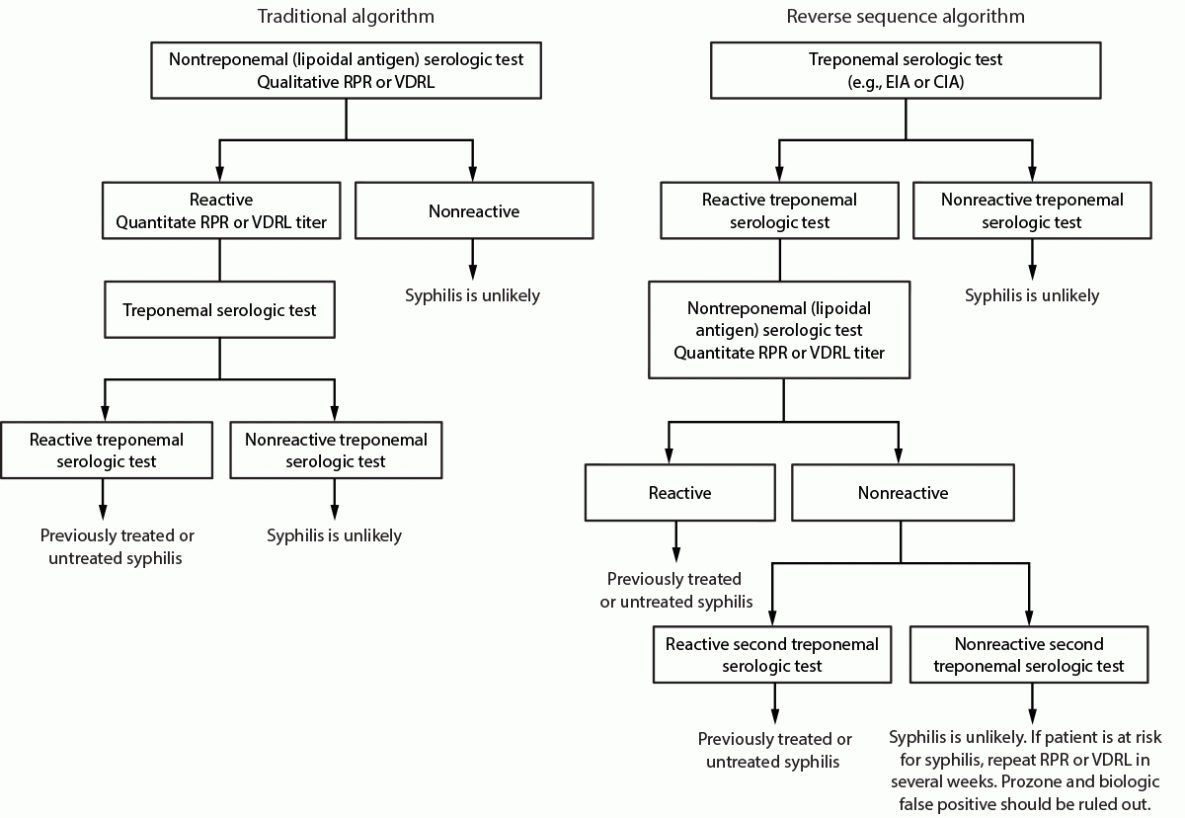
Traditional and reverse-sequence serologic screening, from CDC’s 2024 laboratory recommendations. For newborn management, use the newborn assessment and congenital syphilis treatment guidance.
Text description of the figure
Traditional sequence: Start with RPR or VDRL. If reactive, quantify the titer and perform a treponemal test. A reactive treponemal result can reflect previously treated or untreated syphilis. A nonreactive initial or confirmatory result makes syphilis unlikely in the diagram.
Reverse sequence: Start with a treponemal test, such as EIA or CIA. A nonreactive initial result makes syphilis unlikely in the diagram. If reactive, obtain a quantitative RPR or VDRL. A reactive result can reflect previously treated or untreated syphilis. If the nontreponemal result is nonreactive, use a second treponemal test to resolve the discordance. A reactive second treponemal result can reflect previous or untreated infection; a nonreactive result makes syphilis unlikely.
The figure advises repeat RPR or VDRL in several weeks when the second treponemal test is nonreactive but the patient is at risk. It also calls for ruling out prozone and biologic false-positive results. Interpret the diagram with the full CDC report and clinical context.
Go to the original guidance
- CDC congenital syphilis treatment guidance →Newborn scenarios, older-infant guidance, and follow-up.
- AAP congenital syphilis guide →Public evaluation and treatment guide. Proprietary algorithms remain on the original publisher’s site.
- CDC clinical guidance index →Current STI clinical guidance and updates.
- ACOG screening FAQs →Questions for obstetric clinicians.
Keep the clinical context
Clinical staging, examination, laboratory interpretation, and follow-up reliability require professional judgment. Consult pediatric infectious diseases and pharmacy for complex cases, allergies, shortages, organ dysfunction, and unsupported circumstances.
Population surveillance and individual clinical management serve different purposes. State selection changes the resource context, never the national clinical rules.